
DIGITAL MARKETING
JUNE 8, 2026
SEO in 2026: What Still Works and What’s Changing
A business owner who has spent years investing in SEO could be forgiven for feeling a little unsettled in 2026. Search results look different, AI tools answer questions that once required several website visits, and every week seems to bring another acronym or a new promise about getting found online.

About the Author
Andrew E. Schwartz
Founder & Principal, AED-IS
Andrew helps businesses apply technology and AI in practical ways to improve operations, enhance customer experiences, and drive sustainable growth.
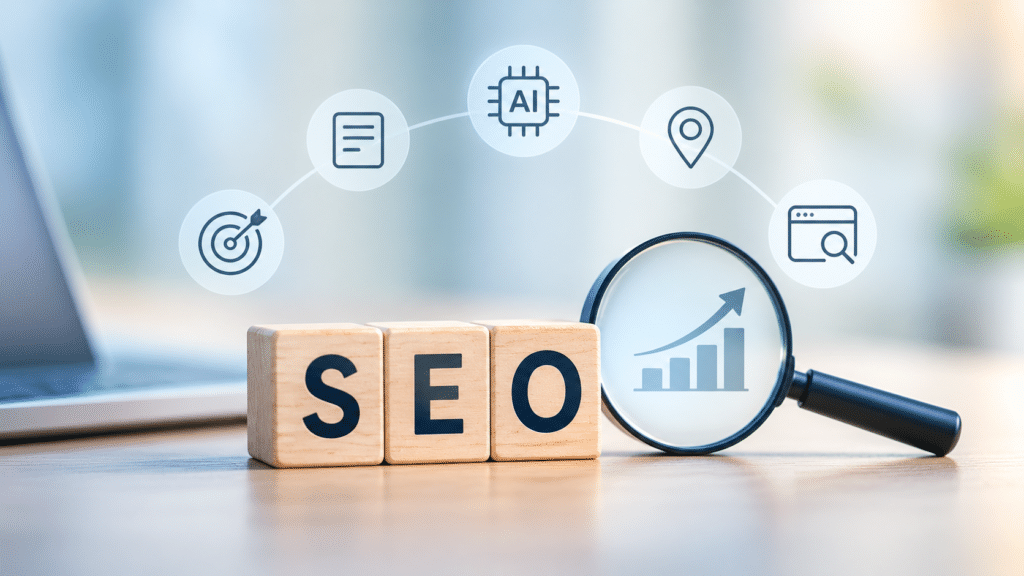
Does that mean the work you have already done on your website is losing its value? Not necessarily. A useful website, a strong reputation and a clear understanding of your customers remain valuable. What is changing is the journey people take before they reach you.
The challenge is to adapt to that journey without abandoning the fundamentals that make a business worth finding in the first place.
1. Is Traditional SEO Still Relevant in 2026?
Yes. Search engine optimization remains an important part of digital marketing. In its May 2026 guidance on generative AI search, Google reaffirmed the relevance of established SEO practices. Its AI search experiences build on existing search systems rather than replacing them entirely. [1]
Consider a local accounting firm that has spent several years building useful service pages, earning genuine customer reviews and publishing helpful tax-related articles. Those assets do not suddenly become irrelevant because a prospective client now uses an AI assistant to explore accounting services.
The better question is whether those assets still answer the questions customers are asking today. A website that has not been updated in three years may need attention, but that is a reason to improve it, not to discard the strategy behind it.
2. The SEO Fundamentals That Still Work
Start with your service pages. Can a prospective customer understand what you offer, who you help and how to get in touch without searching through several menus? A page that describes a service in vague terms may rank for a few keywords but still fail to generate inquiries.
Technical SEO matters too. Search engines need to be able to discover and process the pages you want people to find. Broken links, accidental indexing restrictions, confusing redirects and duplicate URLs can undermine otherwise good content. Maintain a sensible site structure and use relevant internal links to connect related pages.
Then there is reputation. A genuine recommendation from a respected industry association, a useful mention in a trade publication or a well-documented customer case study can help people discover and evaluate your business. Pursue these opportunities for their real value rather than buying large quantities of questionable backlinks.
None of these activities is particularly glamorous. They are, however, the kind of work that builds a dependable online presence over time.
3. How AI is Chanjing the Customer Journey
Imagine someone looking for a new website for a growing business. Previously, they might have searched for a web development company and visited several websites. Today, they might begin by asking an AI assistant which platform would suit their business, what a redesign typically involves and how to evaluate a development partner.
By the time they reach a company’s website, they may already have a reasonably clear picture of what they need.
For businesses, that creates both an opportunity and a challenge. Some questions can be answered without a website visit, while others may lead to a more informed prospect. Do not assume that every AI mention will produce traffic or that every reduction in organic clicks means your business is losing customers.
Your website should help customers at different stages: from understanding their problem to comparing solutions and deciding whether to contact you. A detailed guide explaining the trade-offs between two ecommerce platforms, for instance, can be more helpful than another page simply claiming that your company builds great online stores.
4. SEO, GEO AND AEO: What is the Difference?
SEO (Search Engine Optimization) focuses on improving a website’s discoverability in search results.
GEO (Generative Engine Optimization) refers to efforts to improve how a business and its content are discovered, referenced or represented in AI-generated answers.
AEO (Answer Engine Optimization) focuses on making information useful and understandable when people seek direct answers to specific questions.
These are overlapping approaches, not three entirely separate marketing disciplines. For Google’s generative search features, there is no special AI-only schema or mandatory additional file required. [2] Other AI platforms may have different discovery and access mechanisms, so their guidance should be considered separately.
For a small business, the practical starting point is straightforward: explain your services clearly, answer genuine customer questions and support important claims with reliable evidence. Be wary of anyone promising guaranteed placement in AI-generated answers.
5. Build Authority By Sharing What You Actually Know
One of the difficulties with online content today is that much of it sounds the same. A business owner searching for help with a complex decision can easily encounter several articles that repeat similar advice without explaining what to do next.
Your own business experience can help you produce something more useful.
A property management company could explain what tenants should check before signing a lease. A software development firm could discuss the circumstances in which custom software makes more financial sense than a subscription product. A retailer could publish a comparison based on the products its customers actually use.
Develop a connected collection of articles around the subjects your business knows well. Link them to relevant service pages and to each other where that helps the reader. This is often described as building topical authority, although there is no universal authority score that guarantees rankings.
AI can assist with drafting and organizing ideas, but someone with relevant knowledge should review the material, check the facts and contribute practical detail before publication. Publishing fewer useful articles is preferable to maintaining a busy schedule of interchangeable ones.
6. Local SEO Still Deserves Attention
For businesses serving a particular city or region, being visible to nearby customers remains a priority. Someone looking for a local electrician, a commercial cleaning service or a technology consultant is often trying to make a decision, not merely researching a topic.
Keep your Google Business Profile accurate, including opening hours, contact information and relevant service details. Encourage genuine customer feedback and respond professionally to reviews. Make your service areas clear on your website, using location-specific pages only where they offer meaningful information.
A customer should be able to confirm that you serve their area and understand how to reach you. Avoid creating dozens of nearly identical city pages simply to capture more search terms. Local visibility and customer trust are better served by accurate, useful information.
7. A Better Website is Part of A Better SEO Strategy
Think about your own experience visiting a website on a phone. If the page takes too long to load, the text is difficult to read or the contact form refuses to work, how likely are you to stay?
Search visibility is only the beginning of the relationship. Make sure visitors can navigate easily, read your content comfortably and complete important actions without unnecessary effort. Review mobile layouts, image sizes, accessibility and form functionality. Performance improvements should be prioritized according to their effect on actual users, not just a desire to achieve a perfect testing score.
Structured data can help search systems understand appropriate page details, such as article authorship or business information. It should reflect what visitors can actually see, and it does not guarantee enhanced search results.
For many businesses, improving a poorly performing service page may produce more commercial value than attracting additional visitors to it.
8. Measure What Matters to Your Business
Rankings and traffic are useful indicators, but neither pays the bills on its own.
Suppose your website receives fewer visits this quarter, yet generates more relevant inquiries and closes more profitable projects. That may represent a healthier outcome than a traffic increase driven by people who have little interest in your services.
Review organic impressions, clicks and landing pages alongside qualified inquiries, calls, sales and conversion rates. Use Google Search Console and your analytics platform to understand changes, and check with your sales team about the quality of leads. Where AI visibility reporting is available, treat it as another useful indicator rather than a replacement for commercial results.
Be cautious when interpreting AI referral data. Some visits may not be identifiable, and third-party AI visibility scores do not necessarily represent what every customer sees.
9. A Practical 90-Day SEO Plan for Small Businesses
During the first month, establish a baseline. Review your important service pages, indexing, mobile experience and conversion tracking. Identify the questions customers regularly ask and the pages most closely connected to revenue.
In the second month, improve those pages and publish one or two substantial articles that address real customer needs. Add relevant internal links, update business listings where applicable and resolve technical issues that interfere with discovery or usability.
During the third month, evaluate the results. Look at search visibility, customer engagement and inquiries. Ask whether the content is reaching the right audience, and decide what to improve next.
Ninety days is a useful planning period, not a promise of ranking improvements. Competitive markets and new websites may require considerably longer. The goal is to establish a process that keeps improving rather than chase a different tactic every month.
Frequently Asked Questions
Is SEO worth investing in in 2026?
Yes, when it is aligned with customer demand and business objectives. The appropriate budget depends on your market, competition, website condition and expected commercial value.
Will AI replace traditional search engines?
AI is changing how people discover information, but conventional search continues to serve many purposes. Businesses should prepare for multiple discovery channels rather than assume that one will replace all the others.
Do I need a separate GEO or AEO strategy?
Not necessarily. Strong SEO and useful content provide a foundation. Additional platform-specific work may be appropriate depending on your audience and the AI services they use.
Can AI-generated articles rank on Google?
AI assistance is not automatically disqualifying. Accuracy, usefulness and originality matter, and mass-producing low-value pages to manipulate rankings can violate Google’s spam policies. [3]
How long does SEO take to deliver results?
There is no fixed timeline. Some technical improvements can have relatively quick effects, while competitive ranking and lead-generation improvements may take several months or longer.
The Bottom Line
SEO in 2026 is less about chasing every new development and more about understanding how your customers find, evaluate and choose a business.
Keep the foundations strong. Make your website useful, share the knowledge that makes your business different and pay attention to the results that matter commercially. As search continues to change, those are investments that remain worth making.
About the Author
Andrew E. Schwartz
Founder & Principal, AED-IS
Andrew helps businesses apply technology and AI in practical ways to improve operations, enhance customer experiences, and drive sustainable growth.
Categories
Related Articles

Stay Informed
Get practical insights on Al, technology and digital growth right to your inbox.
Let’s Build A Stronger
Digital Presence
At AED-IS, we help businesses strengthen their online visibility through SEO, digital marketing and website improvements that support their wider business objectives. Whether you are reviewing an existing strategy or exploring AI-powered search, we would be happy to start with a conversation.